
Flexible Packaging Materials Explained: PE, PET, OPP, and MLLDPE
Flexible packaging materials are the building blocks of every stand up pouch, flat bottom bag, and roll film you see on store shelves. Understanding the properties of each material helps you make…
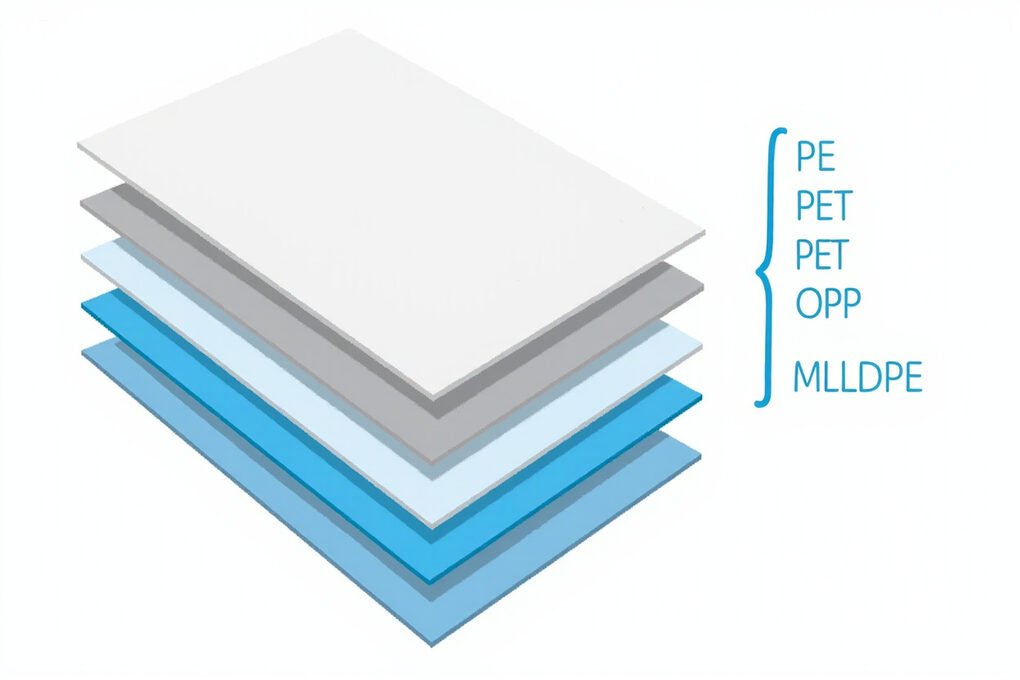
Flexible packaging materials are the building blocks of every stand up pouch, flat bottom bag, and roll film you see on store shelves. Understanding the properties of each material helps you make smarter decisions about your packaging structure and budget.
The Basic Structure of Flexible Packaging
Most flexible packaging uses multi-layer structures where each layer serves a specific purpose:
- Outer layer (print surface) — Provides the printable surface and external durability
- Barrier layer — Prevents oxygen, moisture, and light from entering or exiting
- Seal layer — Creates the heat seal that closes the package
No single material does everything well, which is why multi-layer coextrusion and lamination combine materials to optimize performance.
Common Flexible Packaging Materials
PE (Polyethylene)
PE is the workhorse of flexible packaging, used as the inner seal layer in almost all food packaging bags.
Types of PE:
- LDPE (Low Density PE) — Flexible, excellent seal strength, good clarity. Used for bread bags and flexible pouches.
- LLDPE (Linear Low Density PE) — Stronger seal than LDPE, better puncture resistance. Common in food packaging.
- MLLDPE (Metallocene LLDPE) — Superior puncture and impact resistance. Used in heavy-duty applications like pet food and industrial bags.
PET (Polyethylene Terephthalate)
PET is the most common outer layer material for flexible packaging, prized for its:
- Excellent print surface (accepts all ink systems)
- High tensile strength and puncture resistance
- Good barrier properties against moisture and gases
- Temperature resistance from freezer to hot fill
Used as the outer/front panel in most stand up pouches and flat bottom bags.
OPP (Oriented Polypropylene)
OPP offers excellent clarity and a crisp, premium appearance.
- Monoaxial OPP — Stretched in one direction, used for snack packaging where tears propagate easily (tearable pouches)
- Biaxial OPP (BOPP) — Stretched in both directions, used for packaging where clarity and print quality are paramount
OPP has relatively poor barrier properties unless coated or metallized.
Aluminum Foil
Foil provides the ultimate barrier against oxygen, moisture, and light—but adds cost and is opaque.
Foil is typically used as a barrier layer laminated between PET (outer) and PE (inner) to create premium barrier structures for coffee, nuts, and long-shelf-life products.
EVOH (Ethylene Vinyl Alcohol)
EVOH is a transparent high-barrier polymer used as an intermediate layer in multi-layer structures.
It provides excellent oxygen barrier (even better than foil when dry) but loses barrier properties rapidly when exposed to moisture—which is why it must be sandwiched between two moisture-resistant layers like PE.
Choosing the Right Material Structure
| Application | Typical Structure | Key Properties |
|---|---|---|
| Snacks (low barrier need) | PET/PE or OPP/PE | Good seal, printable, cost-effective |
| Coffee (high barrier) | PET/Foil/PE or PET/MET PET/PE | Maximum oxygen and moisture barrier, degassing valve |
| Pet food (heavy, high fat) | PET/PE or MATTE OPP/PE with MLLDPE seal | Strong seal, puncture resistant, good barrier |
| Freezer-to-microwave | PET/PE or specially formulated PE grades | Freezer-safe seal, temperature resistance |
| Liquid (hot fill) | PET/PE with retort-grade structure | Heat resistance, strong seal integrity |
Frequently Asked Questions
What is the difference between PE and OPP as a packaging material?
PE is flexible, has excellent heat sealability, and is used as the inner seal layer. OPP is rigid, offers superior clarity and print quality, and is typically used as the outer layer. They are almost always laminated together—OPP on the outside for printing, PE on the inside for sealing.
What is MLLDPE and why is it used in pet food bags?
MLLDPE (Metallocene LLDPE) offers superior puncture resistance and impact strength compared to standard PE. Pet food kibble has sharp edges that can stress bag seals and cause punctures. Adding MLLDPE to the seal layer significantly improves bag integrity during handling and transit.
Can GGPbag recommend the right material structure for my product?
Yes. Tell us your product type, shelf life requirements, storage conditions, and target price—and our team will recommend the optimal material structure balancing performance and cost.